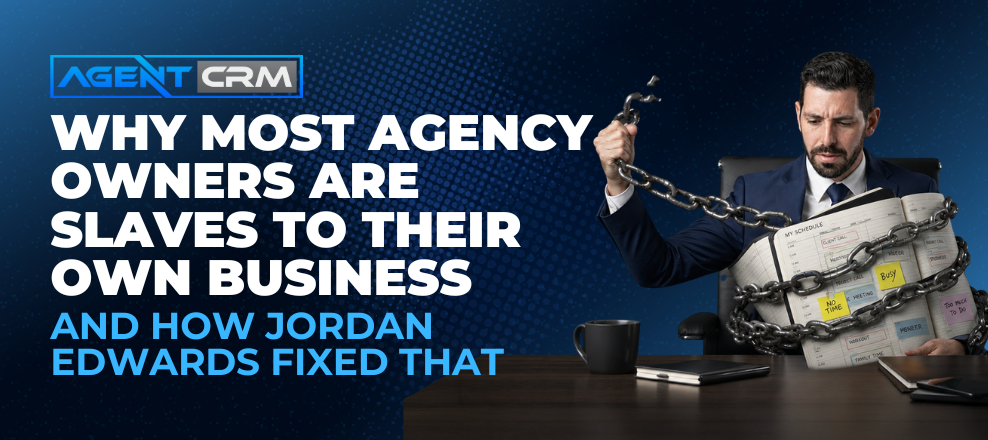
There is a version of agency ownership that nobody warns you about when you are getting started.
It is the version where you are the first one up in the morning and the last one to put the phone down at night. Every notification pulls you in a different direction. Every client feels like an emergency. Every small task somehow becomes your responsibility.
You built something that was supposed to give you freedom.
Instead, it owns every waking hour of your day.
Most agency owners know this version intimately. They know what it feels like to constantly react, constantly respond, and constantly feel behind no matter how much they work.
And many of them have accepted it as just the way things are.
Jordan Edwards does not accept that.
In his conversation with Alex Branning on the Agency Acceleration Lab, Jordan breaks down exactly why most agency owners end up trapped inside their own business — and what it actually takes to get out.
The Version of Agency Ownership Nobody Wants
A lot of agency owners start with the promise of freedom.
They want more control over their income. They want more control over their schedule. They want to build something that gives them options.
But somewhere along the way, the business starts demanding more than it gives.
The owner becomes the sales department, the service department, the admin team, the problem solver, the follow-up person, the client support line, and the emergency contact for everyone.
That is not freedom.
That is a job with more stress, more risk, and fewer boundaries.
The dangerous part is that it can feel normal. When you are the owner, it is easy to tell yourself, “This is just what it takes.”
But there is a difference between working hard and being owned by your business.
That difference usually comes down to control.
The Moment Alex Realized Something Had to Change
Alex has been open about the fact that he lived this.
There was a period where he was going from the moment he woke up to the moment he went to bed. He was stuck in a cycle of reacting, doing admin, responding to issues, and feeling like he was working harder than anyone but still not getting ahead.
His business coach at the time gave him a simple assignment.
Write out your ideal day, minute by minute, from the moment you wake up to the moment you go to bed.
What would it look like if everything was working the way you wanted it to?
Alex did the exercise.
Then his coach gave him a challenge that felt impossible:
Starting today, stop work at 5 PM.
Not wind down at 5.
Not “try to wrap things up.”
Stop.
No computer. No phone. Done.
Alex’s first reaction was that it could not be done. There was too much to handle. Too many things needed his attention. Too many problems would stack up if he stepped away.
But he was coachable enough to try it.
What happened surprised him.
He got more done.
Not less.
More.
Why a Hard Stop Creates Better Work
When you give yourself a hard stop, you stop treating your time like it is unlimited.
That changes how you work.
You get more selective about what actually deserves your attention. You stop letting low-value tasks expand to fill the entire day. You make faster decisions about what matters, what can wait, what can be delegated, and what should not be on your plate at all.
Most agency owners do not realize how much of their day is filled with activity that feels necessary only because they have never forced themselves to operate inside a real constraint.
If you assume you can always work later, you will keep pushing low-value tasks into the evening.
If you decide the workday ends at 5 PM, you start asking better questions during the day.
Does this need to be done right now?
Does this need to be done by me?
Is this actually moving the business forward?
That shift — from being owned by your business to being the one in control — is what Jordan Edwards helps agency owners make every day.
The Identity Shift That Makes Everything Else Possible
One of the most powerful points Jordan made in the conversation is that the real breakthrough happens when an agency owner stops trying to do everything and starts seeing themselves as the facilitator of the opportunity.
That is an identity shift.
It is not just a productivity hack.
Most time management advice focuses on calendars, batching, task lists, and better routines. Those things can help, but they will not stick if the owner still believes they have to be the one handling every call, responding to every message, and solving every problem.
Behavior follows belief.
If you believe your clients will leave the moment you are not immediately accessible, you will keep making yourself immediately accessible.
If you believe the team cannot function unless you are involved in every decision, you will keep inserting yourself into every decision.
If you believe every problem is your problem, your calendar will always prove you right.
The first step is not just changing your schedule.
The first step is changing how you see your role.
You are not supposed to be the person who does everything.
You are supposed to build the environment, systems, and team that make the opportunity work without you being the bottleneck.
Start With a Time Audit
Jordan’s answer to overwhelmed agency owners is direct:
Audit your time first.
Before you change anything, spend one week tracking where your time is actually going hour by hour.
That may sound simple, but it is powerful.
Most agency owners who feel like they are in chaos do not actually know what is causing the chaos. They just know they are exhausted.
The time audit shows the truth.
It reveals the calls that did not need to happen, the conversations that went nowhere, the reactive tasks that consumed hours, and the small interruptions that quietly destroyed the focused time you were supposed to spend on higher-value work.
You may discover that you are spending too much time in client support.
You may discover that your team asks you the same questions repeatedly because there is no documented process.
You may discover that you are using your most valuable hours on tasks that should be templated, automated, or delegated.
You cannot fix what you refuse to measure.
The time audit gives you the visibility you need to make better decisions.
What It Actually Looks Like to Take Back Your Time
Jordan’s approach is not complicated.
It comes down to three practical ideas:
Batching.
Boundaries.
Better questions.
These are not flashy concepts, but they work because they attack the real issue: agency owners are too available, too reactive, and too willing to keep low-value work on their own desk.
If you want control of your time again, you need to change the rhythm of how work reaches you.
Batching: Stop Letting Notifications Run Your Day
Batching means creating focused blocks of time where you are not constantly interrupted.
That may mean turning off notifications. It may mean putting your phone on Do Not Disturb. It may mean closing the inbox. It may mean letting calls and messages wait until a specific response window.
Instead of responding to every message the second it arrives, you create a designated window to handle communication.
For example, you might decide that from 4 PM to 5 PM each day, you respond to everything that came in during the day.
That keeps you in control of the flow.
Without batching, your day belongs to whoever contacts you next.
With batching, your day belongs to you.
This is a major difference.
Agency owners often underestimate the cost of interruption. A quick text, a short call, or a small Slack message may seem harmless, but each one pulls you out of focus. Over the course of a day, those interruptions create the feeling that you worked all day without ever doing the work that mattered most.
Batching protects your attention.
And attention is one of the most valuable assets an agency owner has.
Boundaries: Set Expectations Before People Set Them for You
Boundaries are not about ignoring clients or being unavailable.
They are about setting clear expectations so people know when and how you respond.
Jordan makes a simple point:
If you tell someone you will get back to them within 48 hours and then you respond in 12, they do not feel underserved.
They feel impressed.
You beat the expectation you set.
That is a better client experience than being instantly available all the time and occasionally missing things because you are spread too thin.
The problem with instant availability is that it trains people to expect instant access. Once that expectation exists, anything less feels like bad service.
Boundaries reverse that.
They create a standard you can consistently exceed.
This is not just better for the owner. It is better for the client, because consistency builds trust.
Clients do not need access to you every second of the day.
They need confidence that they will be taken care of.
Those are not the same thing.
Better Questions: Should This Even Be on Your Desk?
The third part of Jordan’s approach is asking better questions.
Agency owners need to constantly ask themselves:
Does this task need to be done by me?
Could this be templated?
Could this be automated?
Could this be delegated?
Is what I am doing right now worth my hourly rate?
Or am I doing something that should be on someone else’s desk?
These questions are uncomfortable because they force you to confront how much of your day is spent below your actual value.
A lot of agency owners are doing $20-per-hour tasks while trying to build a six- or seven-figure agency.
That does not work long term.
At some point, you have to protect your highest-value work.
That means sales, recruiting, leadership, strategy, team development, partnerships, and the decisions that only you can make.
Everything else needs to be questioned.
Not because those tasks are unimportant, but because not every important task should be done by the owner.
Moving From Reactive Work to Leverage Work
Jordan’s framework helps agency owners move from low-level reactive activity into higher-leverage work.
Reactive work is the work that keeps you busy but does not necessarily grow the agency.
It includes constant message checking, random client issues, small admin tasks, unnecessary meetings, repeated explanations, and decisions that should have already been documented.
Leverage work is different.
Leverage work builds the business.
It includes creating systems, hiring the right people, documenting processes, improving the client experience, building marketing assets, developing leaders, and making strategic decisions that compound over time.
Most agency owners say they want to work on the business, but their calendar shows they are still trapped inside the business.
The shift starts when you stop asking, “What needs my attention right now?” and start asking, “What work will create more freedom, capacity, and growth later?”
That is a completely different way to lead.
What Is Waiting on the Other Side
Alex said it clearly in the conversation:
When he finally made the shift and started protecting his time, he did not just get his evenings back.
He got more done during the day.
He showed up better for his team.
He had the mental space to think strategically instead of constantly reacting to whatever was in front of him.
That is what is waiting on the other side of this for agency owners.
Not just a cleaner calendar.
A better business.
Because when the owner is constantly exhausted, the business eventually feels that. The team feels it. Clients feel it. Decisions suffer. Growth slows down. Everything becomes harder than it needs to be.
But when the owner protects their time and energy, they can lead from clarity instead of survival.
That is when the business starts to feel like something you are building again, not something you are trapped inside.
Where to Start This Week
If this sounds familiar, start small.
Do not try to redesign your entire business in one day.
Start with one week of tracking your time.
Write down where every hour goes.
Then look for patterns.
Which tasks keep repeating?
Which conversations did not need to happen?
Which requests could have been handled by a template?
Which issues could have been prevented by a better system?
Which tasks should not be on your desk at all?
From there, create one boundary.
Maybe you stop work at a specific time.
Maybe you turn off notifications for two hours each morning.
Maybe you only check messages during specific windows.
Maybe you create a response-time expectation for clients and team members.
The goal is not perfection.
The goal is control.
Every small boundary is a step toward becoming the owner of your business again.
Final Takeaway
Most agency owners do not become slaves to their business overnight.
It happens gradually.
One extra message.
One extra late night.
One extra client emergency.
One extra task they should have delegated but did not.
Eventually, the business that was supposed to create freedom becomes the thing consuming all of it.
Jordan Edwards’ message is simple:
You can take the time back.
But it starts with seeing your role differently, auditing where your time is actually going, setting better boundaries, batching your communication, and asking whether the work on your desk truly belongs there.
Freedom does not come from doing more.
It comes from leading differently.
How Agent CRM Frees Up Your Time to Focus on Growth
One of the biggest challenges agency owners face is this: while you are working on your people, your culture, and your systems, leads are still coming in and expecting follow-up.
That tension — between building the agency and running the agency — is where most owners get stuck.
Agent CRM is built to solve that problem.
LOANNE is Agent CRM’s AI voice assistant. She reaches out to new insurance leads the moment they come in — calling, texting, and following up automatically — so your pipeline keeps moving even when you are focused on the bigger picture. No more leads going cold because you were in a hiring interview or an agency training session.
AgentAI is the conversational AI built into your pipeline. It responds to inbound messages, qualifies leads, and books appointments without you or your team lifting a finger. For agencies building toward a system that runs without the owner in every conversation, AgentAI is the practical first step.
Both tools are included with every Agent CRM plan, starting at $97/month. When your follow-up system runs on its own, you get to focus on what actually grows the agency — the hiring, the culture, the leadership, and the strategy.
Build a Better Agency Starting Today
Agent CRM gives insurance agents and agency owners the system they need to follow up faster, manage leads consistently, and grow without the chaos.
- Agent CRM Starter — $97/month · Includes Branning Bundles, AgentAI, LOANNE, and 24/7 support. Start with a 14-day free trial.
- Agent CRM Pro — $197/month · Adds unlimited 1-on-1 coaching, The Growth Rooms, and advanced ad tools for agencies ready to scale.
👉 Start your 14-day free trial of Agent CRM
📅 Book a consult with our team
🎙️ Listen to Agency Acceleration
More from this series:
- The Four Levels of Time Management Every Agency Owner Needs to Know
- Jordan Edwards Revealed the Real Reason Your Agency Isn’t Growing
- The $17 Phone Call That Changed How John Whetmore Built His Agency
Frequently Asked Questions
What is Agent CRM?
Agent CRM is a CRM and marketing automation platform built specifically for insurance agents and agency owners. It includes built-in tools for lead follow-up, pipeline management, appointment booking, automated nurture sequences, and AI-powered assistants like LOANNE and AgentAI. It is designed to help agents and agency owners spend less time on manual tasks and more time on the work that actually grows the business.
How can Agent CRM help me scale my agency?
Agent CRM automates the parts of your business that drain your time without generating results — manual follow-up, lead sorting, appointment reminders, and no-show recovery. When those processes run automatically, you can focus on hiring, leadership, and agency growth instead of getting pulled into every lead conversation.
What does Agent CRM cost?
Agent CRM Starter is $97 per month and includes Branning Bundles, AgentAI, LOANNE, and 24/7 support. Agent CRM Pro is $197 per month and adds unlimited 1-on-1 coaching, The Growth Rooms, and advanced advertising tools. Both plans include a 14-day free trial so you can see the system in action before committing.
What is LOANNE?
LOANNE is Agent CRM’s built-in AI voice assistant. She automatically calls new leads, confirms appointments, and follows up after-hours — without you or anyone on your team picking up the phone. For agency owners who want their lead pipeline to stay active even when they are focused on other priorities, LOANNE handles that work automatically.
Can Agent CRM work for agencies that are actively building or restructuring their team?
Yes. Agent CRM is especially useful during growth phases because it takes manual lead management off your plate. When you are hiring, onboarding new agents, building systems, or restructuring how your agency operates, the last thing you want is leads falling through the cracks. Agent CRM keeps the pipeline moving so your business does not stall while you are working on building the team.