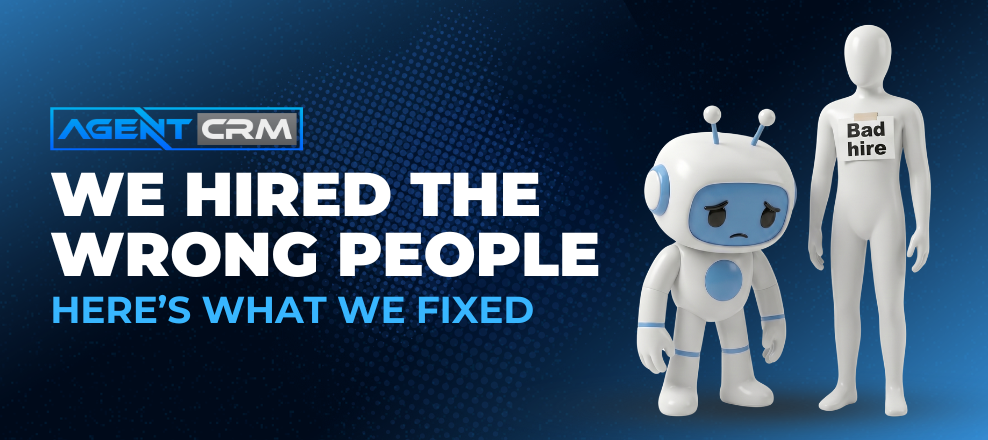
Every agency owner has a hiring horror story.
Someone looked great on paper.
They interviewed well.
They had the experience.
They said all the right things.
Then they showed up on day one and slowly started poisoning the team around them.
Or maybe they weren’t toxic, but they just couldn’t follow a process no matter how many times you walked them through it.
We had those stories at Agent CRM.
More than a few of them.
And for a long time, we chalked it up to bad luck.
Wrong person.
Wrong timing.
Tough market for talent.
We told ourselves the usual things leaders tell themselves when they don’t want to look at the real issue.
But eventually, we had to admit the truth.
The problem was us.
Not because we were bad leaders.
But because we were hiring without a real filter.
We knew what skills we needed.
We knew what the role required.
We knew what tasks needed to get done.
But we did not know clearly enough who we were as a company and what kind of people actually belonged on our team.
And when you don’t know that, you hire based on vibes.
Vibes do not build great agencies.
The Moment Things Started to Change
When Will Winter joined Agent CRM, one of the first things he did was ask a question that sounds simple, but isn’t:
👉 Who do we actually want on this team?
Not just:
“What skills do we need?”
Not just:
“What experience should they have?”
But:
Who belongs here?
What do they believe about work?
How do they handle hard days?
How do they treat people?
How do they respond to structure, growth, pressure, and feedback?
That conversation led to something we should have done much earlier.
We wrote out our core values.
Not as cute wall art.
Not as corporate fluff.
But as real filters for real decisions.
The Core Value That Changed Our Hiring
One of the values we landed on was a commitment to process.
That mattered because Agent CRM was onboarding a massive number of agents every single day.
We needed people who could operate inside systems.
People who could follow established workflows.
People who could document what they were doing.
People who would not freelance their way through every task just because they thought they knew better.
That sounds obvious now.
But at the time, we had not said it clearly enough.
We had not put it in writing.
And because we had not defined it, we kept hiring people who were talented but allergic to structure.
Then we wondered why things kept breaking.
The issue was not always skill.
Sometimes, the issue was fit.
What We Actually Fixed
Once we got clear on our values, we made three changes that improved the quality of our hires almost immediately.
1. We Put Our Values at the Top of the Hiring Funnel
We stopped burying our values at the bottom of a job description.
Instead, we put them front and center.
We used video.
We used direct language.
We explained what it was really like to work with us.
The goal was not to impress everyone.
The goal was to attract the right people and make it easy for the wrong people to opt out before we ever got on a call.
That is an underrated hiring strategy.
Most agency owners try to convince everyone that their agency is a great place to work.
But strong hiring should also repel the wrong people.
If someone watches your hiring video, reads your values, and thinks, “That does not sound like me,” that is a win.
You just saved yourself time, energy, and future frustration.
2. We Started Asking Better Interview Questions
Before this shift, we asked too many questions about skills and experience.
Those things matter.
But they are not enough.
We needed to understand how people think.
So we started asking questions like:
- How do you respond when a process does not make sense to you?
- What do you do when you disagree with how something is being handled?
- How do you handle repetitive work?
- What kind of team environment helps you do your best work?
- Tell us about a time you had to follow a process you did not create.
Those questions gave us a better look at the person behind the resume.
We were not just listening for polished answers.
We were looking for instincts.
Because instincts show up once the person is actually on the team.
3. We Stopped Treating Every Open Role Like an Emergency
This was one of the hardest shifts.
When you need help, every open role feels urgent.
You feel the pressure.
The team is stretched.
The work is piling up.
Customers need support.
So you start thinking:
“We just need someone.”
That is dangerous.
Urgency is the enemy of good hiring.
When you need someone yesterday, you lower your standards without realizing it.
You overlook red flags.
You excuse weak answers.
You convince yourself you can train around a values mismatch.
But you usually can’t.
A bad hire costs more than an empty seat.
So we got more disciplined about holding the line, even when it was uncomfortable.
Why Skills Alone Are Not Enough
A talented person who does not fit your culture can still create chaos.
They may know the job.
They may be smart.
They may even produce results.
But if they constantly fight the process, drain the team, ignore standards, or bring the wrong energy into the room, they are not a good hire.
Great agencies are not built by collecting talented people randomly.
They are built by aligning the right people around a clear way of operating.
That starts with knowing who you are.
What This Means for Your Agency
If you are making bad hires, the answer is rarely just better job boards.
It is rarely just a bigger talent pool.
It is almost always clarity.
Clarity about:
- who you are
- what you stand for
- how your agency operates
- what behaviors you reward
- what behaviors you refuse to tolerate
- what kind of person actually thrives in your environment
That clarity starts with your core values.
But not fake core values.
Real ones.
The kind you use when hiring.
The kind you use when giving feedback.
The kind you use when deciding whether someone belongs on the team.
If you have not written those down yet, that is your homework before your next hire.
Not as a branding exercise.
As a filter.
Because hiring without a filter is how you end up with people who look right on paper but create problems in practice.
Final Takeaway
We did not fix our hiring by getting lucky.
We fixed it by getting clear.
Clear on who we were.
Clear on what we valued.
Clear on what kind of people belonged on our team.
Clear on what we were no longer willing to tolerate.
That changed everything.
If you want to build a stronger agency, do not just ask, “Who can do this job?”
Ask:
👉 “Who actually belongs in the company we are building?”
That question will save you more pain than almost anything else in the hiring process.
✅ Build a Stronger Agency With Better Systems
👉 Start a free trial of Agent CRM
📅 Book a consult with our team
🎙️ Listen to Agency Acceleration