Most agency owners build their team first and figure out the culture later.
They recruit hard.
They onboard fast.
They deal with the people problems as they come up.
And the people problems always come up.
The agent who does not follow the process.
The team member who brings negative energy to every meeting.
The hire who looked great on paper but turned out to be completely wrong for the environment.
Then they wonder why building a team feels so hard.
Here is what nobody tells you when you are starting out:
👉 The culture you build is the environment your team lives in.
And if you do not build it intentionally before the team arrives, the team builds it for you.
It almost never turns out the way you wanted.
Culture Does Not Wait for You to Be Ready
The moment you bring your first team member on board, a culture begins forming.
Not someday.
Not when you have ten people.
Not when you feel ready to “focus on culture.”
Immediately.
The way you communicate becomes part of the culture.
The behaviors you reward become part of the culture.
The things you let slide become part of the culture.
The energy you bring to a hard week becomes part of the culture.
Your team picks up on all of it.
Then they mirror it back.
If you have not been intentional about what those norms should be, you are not starting from a blank slate.
You are starting from whatever happens to show up.
And hoping it works out is not a strategy.
The Agency Owner’s Real Job: World Building
Will Winter talks about culture as world building.
That phrase matters.
Because as an agency owner, your highest-level job is not just to recruit, train, and produce.
It is to build the world your team lives in.
That world shapes how people think.
It shapes how they behave.
It shapes what they believe is acceptable.
It shapes how they respond when things get hard.
And whether you realize it or not, you are already building that world every day.
The question is:
👉 Are you building it on purpose?
What to Define Before You Hire
Before you bring on your next team member, there are three things worth getting clear on.
Not later.
Before.
Because these decisions affect who you attract, who you repel, how you interview, how you onboard, and how long the right people stay.
1. Define Your Real Values
The first thing to define is your values.
Not a long list of aspirational phrases.
Not words that sound good on a website.
Two or three things that are genuinely non-negotiable about how you operate.
Things you would actually part ways with someone over if they consistently violated them.
That last part is important.
If you would not enforce it, it is not a value.
It is a preference.
For example, if you say you value process, but you allow people to ignore your workflows every day, then process is not really a value.
If you say you value ownership, but you tolerate constant blame-shifting, then ownership is not really a value.
Your real values are not what you claim.
Your real values are what you reinforce.
2. Define the Experience You Want People to Have
The second thing to define is the experience you want people to have.
And not just your customers.
Your team.
What do you want someone to feel on their first day?
Do you want them to feel:
- clear?
- supported?
- challenged?
- welcomed?
- accountable?
- energized?
What do you want them to say about working with you six months in?
What does a good week feel like inside your agency?
What does communication look like?
What does support look like?
What does leadership look like?
Get specific about this before you start recruiting, because it changes who you recruit and how you recruit them.
If you want people to feel supported, you need systems that support them.
If you want people to feel challenged, you need standards.
If you want people to feel clear, you need communication and process.
Culture is not just what you say.
It is what people experience.
3. Define Your Non-Negotiables for Fit
The third thing to define is your non-negotiables for fit.
Beyond skills and experience, what kind of person actually thrives in your environment?
Do you need people who are highly self-directed?
Or do you need people who do better with structure and clear expectations?
Do you need people who are naturally competitive?
Or do you need people who are more collaborative?
Do you need fast movers who can handle constant change?
Or steady operators who love consistency?
There is no universal right answer.
But there is a right answer for your agency.
And knowing it before you hire saves you an enormous amount of pain.
Because a person can be talented and still be the wrong fit for your environment.
That is one of the most expensive lessons agency owners learn.
Why This Order Matters
When you build the culture before you build the team, something interesting happens.
Recruiting gets easier.
Not because there are magically more candidates.
But because you know exactly who you are looking for, and you can communicate it clearly.
The right people recognize themselves in what you are describing.
They lean in.
The wrong people opt out before you waste time on them.
That is what you want.
A strong culture does not attract everyone.
It attracts the right people.
Onboarding Gets Better Too
When your values and expectations are clear from day one, new team members know what they are walking into.
There is less confusion.
Less course-correcting.
Less of that frustrating period where you are trying to teach someone not just their job, but how to be on your team.
Instead, the environment teaches them.
The expectations are clear.
The standards are visible.
The communication is consistent.
That makes onboarding smoother because people are not guessing what matters.
They already know.
Retention Improves When People Feel Aligned
Culture also affects retention.
People stay in environments where they feel like they belong.
When your culture is defined and lived out consistently, the right people feel that alignment.
They understand the mission.
They understand the standards.
They understand how to win inside your agency.
That connection keeps them engaged.
It keeps them bought in.
And it reduces the constant churn that comes from hiring people who were never a fit in the first place.
Where to Start Today
If you already have a team and you are reading this thinking, “I missed my window,” you did not.
It is harder to build culture after the fact, but it is not impossible.
It starts with the same step:
👉 Get clear on who you are and what you stand for.
Then find every way you can to express that in the day-to-day life of your agency.
That means your values need to show up in:
- hiring
- onboarding
- meetings
- training
- feedback
- accountability
- recognition
- leadership decisions
If your values only live in a document, they will not shape the team.
They have to live in the operating rhythm of the agency.
Final Takeaway
Most agency owners build the team first and figure out the culture later.
But by then, the culture is already forming.
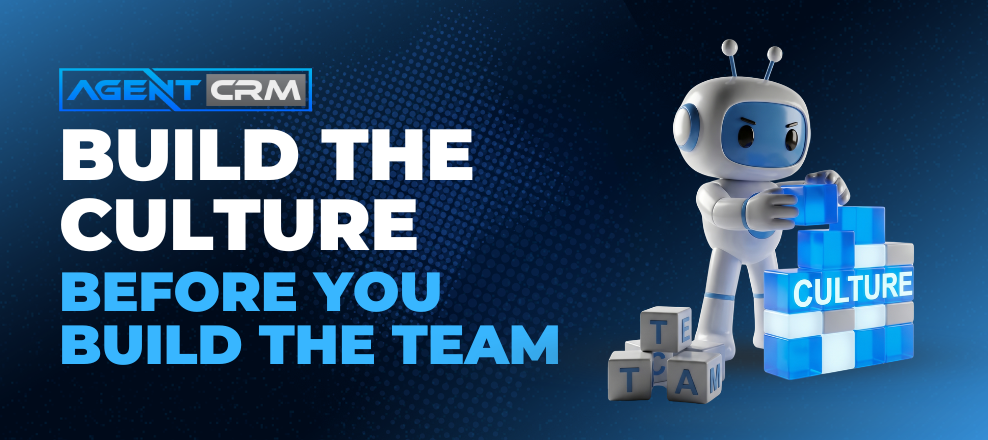
The smarter move is to build the culture before you build the team.
Define your values.
Define the team experience.
Define your non-negotiables for fit.
Then recruit people who belong in that environment.
Because the agency you build is not just a collection of people.
It is a world those people live in.
And the world you build will shape the team you get.
How Agent CRM Frees Up Your Time to Focus on Growth
One of the biggest challenges agency owners face is this: while you are working on your people, your culture, and your systems, leads are still coming in and expecting follow-up.
That tension — between building the agency and running the agency — is where most owners get stuck.
Agent CRM is built to solve that problem.
LOANNE is Agent CRM’s AI voice assistant. She reaches out to new insurance leads the moment they come in — calling, texting, and following up automatically — so your pipeline keeps moving even when you are focused on the bigger picture. No more leads going cold because you were in a hiring interview or an agency training session.
AgentAI is the conversational AI built into your pipeline. It responds to inbound messages, qualifies leads, and books appointments without you or your team lifting a finger. For agencies building toward a system that runs without the owner in every conversation, AgentAI is the practical first step.
Both tools are included with every Agent CRM plan, starting at $97/month. When your follow-up system runs on its own, you get to focus on what actually grows the agency — the hiring, the culture, the leadership, and the strategy.
Build a Better Agency Starting Today
Agent CRM gives insurance agents and agency owners the system they need to follow up faster, manage leads consistently, and grow without the chaos.
- Agent CRM Starter — $97/month · Includes Branning Bundles, AgentAI, LOANNE, and 24/7 support. Start with a 14-day free trial.
- Agent CRM Pro — $197/month · Adds unlimited 1-on-1 coaching, The Growth Rooms, and advanced ad tools for agencies ready to scale.
👉 Start your 14-day free trial of Agent CRM
📅 Book a consult with our team
🎙️ Listen to Agency Acceleration
More from this series:
- Your Culture Is Costing You A-Players
- Core Values Are Useless (Until You Do This)
- The Hiring Funnel Most Agency Owners Skip
Frequently Asked Questions
What is Agent CRM?
Agent CRM is a CRM and marketing automation platform built specifically for insurance agents and agency owners. It includes built-in tools for lead follow-up, pipeline management, appointment booking, automated nurture sequences, and AI-powered assistants like LOANNE and AgentAI. It is designed to help agents and agency owners spend less time on manual tasks and more time on the work that actually grows the business.
How can Agent CRM help me scale my agency?
Agent CRM automates the parts of your business that drain your time without generating results — manual follow-up, lead sorting, appointment reminders, and no-show recovery. When those processes run automatically, you can focus on hiring, leadership, and agency growth instead of getting pulled into every lead conversation.
What does Agent CRM cost?
Agent CRM Starter is $97 per month and includes Branning Bundles, AgentAI, LOANNE, and 24/7 support. Agent CRM Pro is $197 per month and adds unlimited 1-on-1 coaching, The Growth Rooms, and advanced advertising tools. Both plans include a 14-day free trial so you can see the system in action before committing.
What is LOANNE?
LOANNE is Agent CRM’s built-in AI voice assistant. She automatically calls new leads, confirms appointments, and follows up after-hours — without you or anyone on your team picking up the phone. For agency owners who want their lead pipeline to stay active even when they are focused on other priorities, LOANNE handles that work automatically.
Can Agent CRM work for agencies that are actively building or restructuring their team?
Yes. Agent CRM is especially useful during growth phases because it takes manual lead management off your plate. When you are hiring, onboarding new agents, building systems, or restructuring how your agency operates, the last thing you want is leads falling through the cracks. Agent CRM keeps the pipeline moving so your business does not stall while you are working on building the team.