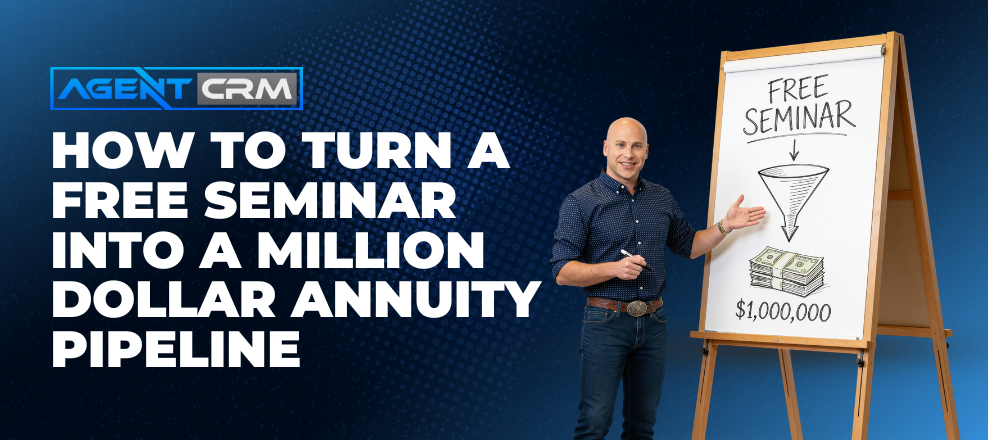
Most agents think of seminars as an expensive, time-consuming way to generate leads.
They picture dinner events at nice restaurants, fancy invitations, large upfront costs, and a room full of people who may be more interested in the free meal than the financial conversation.
Roy Snarr does it differently.
He does not rely on dinner seminars.
He teaches at libraries and community colleges.
No dinner.
No fancy setup.
No expensive meal cost.
Just education.
And after more than 300 seminars using this model, his pipeline has never run dry.
The reason is simple: Roy is not trying to attract people with food.
He is attracting them with answers.
Why Free Seminars Outperform Paid Dinner Events
The dinner seminar model has a built-in problem.
Many people show up because of the free meal, not because they are genuinely interested in financial planning.
That creates resistance before the presentation even begins.
The audience may be skeptical. They may assume there is a sales pitch coming. They may feel like they are sitting through the talk because they are being fed.
That is not the strongest starting point for a trust-based conversation.
Roy’s model removes that issue.
When someone attends a free educational workshop at a library or community college, they are usually there for the topic.
And the topic Roy teaches is Social Security.
That matters because Social Security is something people already care about. They have questions about it. They are confused by it. They know the decision matters, and they want clarity.
So the room is naturally more engaged.
They are not there for dinner.
They are there to learn.
That creates a completely different energy.
Why Social Security Fills the Room
Social Security works because it is one of the most important retirement topics for boomers.
People want to know when they should file. They want to understand how to maximize their benefit. They want to know what happens if a spouse passes away. They want to know how Social Security fits into the rest of their retirement income.
Most people do not feel confident about these decisions.
That uncertainty creates demand.
When Roy advertises a free Social Security workshop, he is not pushing a product. He is offering clarity on a topic people already know they need help with.
That is why the model works.
The seminar is not positioned as an annuity event.
It is positioned as education.
And education earns trust much faster than a product pitch.
The Seminar Flow That Turns Education Into Appointments
Roy’s seminar structure is straightforward.
He teaches Social Security.
Not lightly.
Not as a throwaway topic before pitching something else.
He really teaches it.
He explains the rules, the options, the decisions, and the common mistakes in a way that helps people feel like they finally understand something that has confused them for years.
Then, at the end of the seminar, he offers to run a personalized Social Security report for anyone who wants one.
That offer is powerful because it is useful.
He is offering to do real work for free.
He can put in their numbers, compare filing scenarios, and show them what their benefit may look like under different conditions.
For the person sitting in the room, that is valuable.
It feels practical.
It feels personal.
And it is directly connected to one of the biggest financial decisions of their retirement.
That is why people say yes.
The Golden Question That Opens the Annuity Conversation
Once Roy sits down with the prospect to review the personalized Social Security report, he asks one simple question:
👉 Is this enough money to retire on?
That question does not feel like a sales pitch.
It feels like the next logical step.
The prospect is already thinking about retirement income. They have just reviewed their Social Security benefit. They can now see what that benefit may provide.
So the question makes sense.
And the answer is usually no.
Social Security is important, but for many people it is not enough by itself.
That opens the door to the bigger retirement income conversation.
Roy can then ask what else they have to retire on and help them understand what is possible.
The annuity conversation becomes natural because the prospect can see the gap for themselves.
That is the power of this model.
Roy is not forcing the sale.
He is guiding the prospect through a conversation they already need to have.
Why Trust Is Already Built Before the Appointment
By the time Roy sits down one-on-one with the prospect, the relationship is already different.
The prospect has heard him teach.
They have seen that he understands Social Security.
They have received value before being asked for anything.
They already believe he knows what he is talking about.
That creates a much warmer appointment than a cold lead or a generic internet inquiry.
The prospect is not wondering, “Who is this person?”
They already have context.
They already have trust.
They already see Roy as a resource.
That is why the appointment can move into deeper planning conversations without feeling forced.
The education did the heavy lifting.
How to Integrate Referral Partners Without Disrupting the Seminar
One of the most practical things Roy shared is how he works with referral partners in a seminar setting.
He does not recommend joint seminars where two speakers split the stage.
That can create problems.
The flow can break down. The rapport can get diluted. The audience may connect with one speaker but not the other. The presentation can start to feel scattered because too many topics are being covered at once.
Instead, Roy keeps the seminar focused.
If he is teaching Social Security, he teaches Social Security.
But he may reference a partner during the presentation.
For example, he might mention that he has a Medicare specialist in the office who can help with Medicare questions.
The partner is in the room.
After the seminar, people can walk up and speak with that person.
This keeps the knowledge separated, the seminar focused, and the audience experience clean.
It also allows both specialists to look like experts.
Roy stays positioned as the Social Security and retirement income expert.
The partner stays positioned as the Medicare expert.
Nobody has to pretend to be everything to everyone.
That is better for the audience and better for the business.
Why This Creates a Better Referral Partner Model
This approach gives referral partners a strong reason to participate without making the seminar feel crowded or confusing.
The partner gets access to the right audience.
Roy keeps control of the flow.
The audience gets a focused educational experience.
And both professionals benefit from being in the room.
That is a much better model than trying to force two different presentations into one event.
When the seminar is clean and focused, trust builds faster.
When each expert stays in their lane, the positioning is stronger.
And when the audience has questions afterward, they know exactly who to talk to.
That is how you create leverage without weakening the presentation.
What Agents Can Learn From Roy’s Seminar Strategy
The lesson is not that every agent has to copy Roy’s seminar exactly.
The lesson is that education works when it is specific, useful, and focused on a question the market already has.
If you are in the senior market, you do not need to lead with products.
You can lead with education.
You can teach Social Security, Medicare, long-term care, retirement income, Roth conversions, or another topic your ideal client already wants to understand.
The key is to make the education real.
Do not use the seminar as a thin excuse to pitch.
Teach something valuable.
Give people clarity.
Then offer a next step that helps them apply what they learned to their own situation.
That is how a free seminar becomes an appointment engine.
Final Takeaway
Roy Snarr’s seminar model works because it starts with trust.
He does not spend money on dinner to get people in the room.
He does not lead with annuities.
He does not pressure the audience into appointments.
He teaches Social Security in a way that helps people make sense of one of the biggest retirement decisions they will face.
Then he offers a personalized report.
Then he asks a simple question:
👉 Is this enough money to retire on?
That one question turns education into a planning conversation.
And that planning conversation can turn into a million-dollar annuity pipeline.
✅ CTA: Build a Better Follow-Up System for Your Seminar Leads
👉 Start your free trial of Agent CRM: http://www.agent-crm.com
Start your free trial and use Agent CRM to manage seminar leads, automate follow-up, organize appointments, and keep every retirement planning prospect moving through your pipeline.
🎙️ Listen to Agency Acceleration: https://agencyacceleration.ai
Listen to Agency Acceleration for practical conversations on marketing, sales systems, lead follow-up, and scaling an insurance agency.
📘 Get Roy’s free resources: http://annuityproducers.com
Download Roy Snarr’s free Social Security and long-term care books so you can start building the expertise that makes your next seminar worth showing up for.