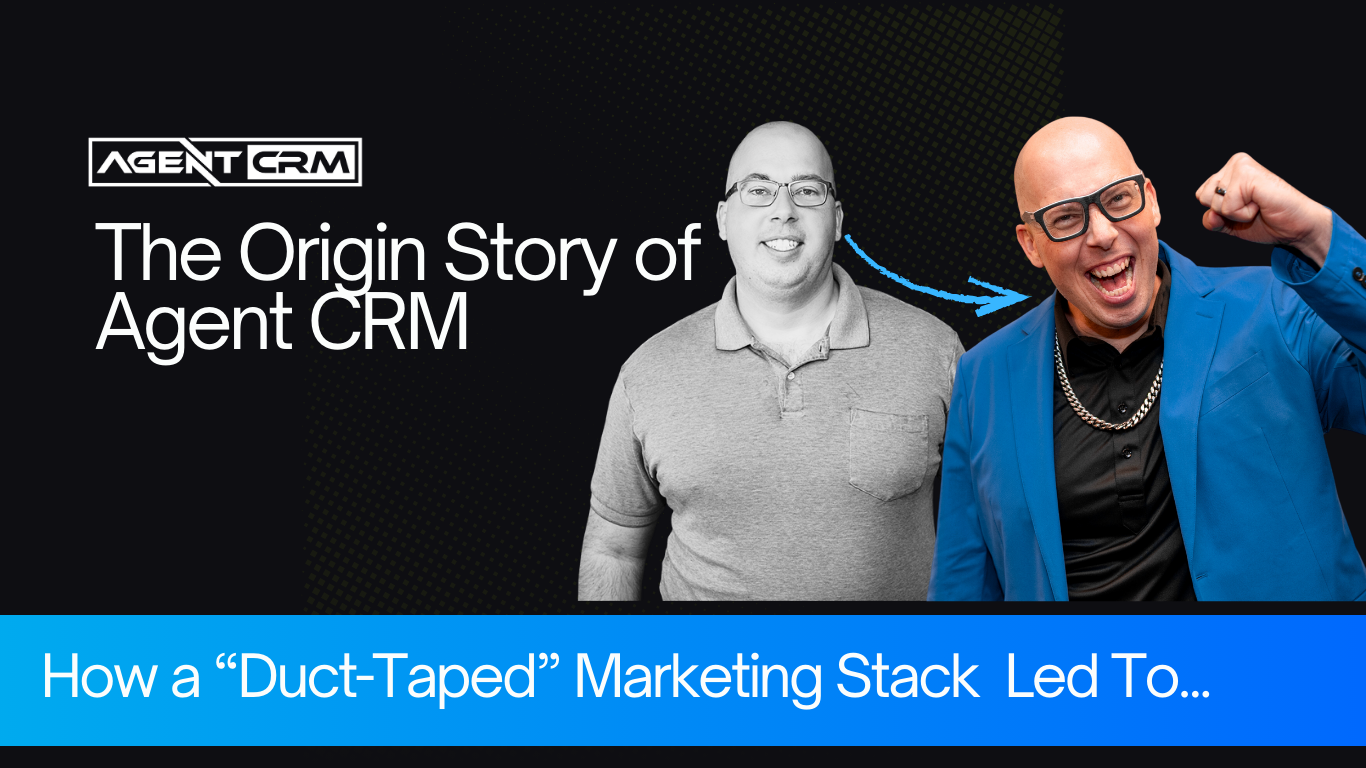
How a “Duct-Taped” Marketing Stack Turned Into Alex Branning Building The Largest Marketing Platform for Insurance Agents
If you’ve ever tried to run modern insurance marketing with five different tools, three logins, and a prayer… you already know how this story starts. It starts with ambition. It starts with growth. And it starts with that sinking feeling you get when your campaigns are working… but your tech stack is one bad Zap away from collapsing.
Agent CRM was born out of that exact moment.
Read More: What is Agent CRM?
Chapter 1: The “Marketing Guy” Years (Before Agent CRM Was a Thing)
Before Agent CRM existed, Alex Branning was doing what a lot of the best marketers do: obsessing over what actually creates revenue.
For more than 10 years, he worked in marketing—with some insurance agencies being superstar clients—helping them get leads, book appointments, and scale production. But like most agency operators, the tech stack was a patchwork: funnels over here, email over there, texting somewhere else, calendars in another place… and every new campaign felt like a fresh round of “software surgery.”
And then 2020 happened.
Chapter 2: The Pandemic Shockwave (When Everything Quadrupled Overnight)
When the pandemic hit, something major shifted in the insurance world:
Agencies that previously relied on in-person relationships and old-school marketing suddenly needed digital marketing—fast.
Alex describes it plainly: the business quadrupled overnight from February to March of 2020.
That’s a blessing… until you realize your tools can’t handle the volume.
At the time, the system was held together with duct tape—using tools like ClickFunnels, AWeber, and other platforms to run multi-step campaigns. The problem wasn’t that these tools were “bad.” The problem was that they weren’t one system.
And when you’re trying to run logic-based follow-up at scale, “not one system” becomes a daily headache.
Chapter 3: Discovering HighLevel (The “Everything Under One Roof” Moment)
In the middle of that chaos, Alex found GoHighLevel.
What stood out immediately wasn’t one feature—it was the architecture:
- booking system
- SMS
- funnels
- pipelines
- all in one place
It wasn’t just cheaper. It was calmer. It reduced both cost and complexity—two things that matter when you’re scaling fast.
And that’s when the lightbulb went on:
“What if insurance agents had this… but actually built for insurance?”
Chapter 4: July 2020 — Agent CRM Launches (And the Name Was a Happy Accident)
By July 2020, Agent CRM was released.
And the name? Alex calls it a “happy accident” that ended up being a major blessing.
Hundreds of agents signed up right out of the gate.
Agent CRM was also one of the earliest GoHighLevel white-labels, and Alex had been close to the HighLevel ecosystem from the beginning (including relationships with early leadership). But what mattered most wasn’t proximity to the platform—it was what the early users revealed immediately:
Insurance agents didn’t just need “tools.”
They needed a system.
Chapter 5: The Two Problems That Wouldn’t Go Away
As Agent CRM grew, two recurring problems became impossible to ignore.
Problem #1: GoHighLevel is powerful… but it requires too much build-out
Insurance agents would see the possibilities, but the reality was brutal:
To make HighLevel work well, you have to build a lot. And most agents don’t want to spend their afternoons building workflows—they want to spend them talking to prospects and clients.
Problem #2: The ecosystem wasn’t built for insurance
HighLevel was created by marketers, for marketers—people selling courses, memberships, and marketing offers.
Insurance is different.
Insurance has compliance, restrictions, and rules that can absolutely wreck an agency if ignored—things like Medicare’s recording requirements, scope of appointment, and permission-based communication. Most generic support can’t guide agents safely through that world.
So Agent CRM made a decision that still defines the platform:
Build the “insurance version” of HighLevel—done right, out of the box.
Chapter 6: The Core Belief That Shaped Everything
Here’s the belief Alex states clearly:
When an insurance agent is inside a CRM building workflows, that is not revenue-generating activity.
So the mission became simple:
Make the system plug-and-play, so agents can get in, customize fast, and get back to selling.
That’s why Agent CRM evolved into what it is today:
- Branning Bundles: complete systems per product
- Add-ons: cross-sell vaults, holiday campaigns, specialty workflows
- Click-and-Play Library: workflows, websites, pipelines, automations, AI—ready to deploy
Chapter 7: The “Aha” Features That Made It Feel Effortless
The Activator (Because “What do I do first?” kills momentum)
Instead of leaving agents to guess setup steps, Agent CRM created the Activator: short 1–3 minute videos guiding a full setup path that can be completed in an afternoon.
The Customizer (So you don’t edit 100 emails ever again)
Agent CRM includes hundreds of prebuilt emails and texts per bundle.
So what happens when you change your phone number, address, logo, or agency branding?
You don’t manually edit everything.
You edit the Customizer once—and your assets update automatically, including conditional logic like only showing social icons if the link exists.
This is the difference between “a template library” and a real system.
Chapter 8: A Real-World Example: The “Dead Leads” That Weren’t Dead
One of the most telling stories in our recent history is about a user (Rusty Noel) who discovered the Revive Dead Leads workflow.
He sent it to roughly 3,000 old contacts.
His phone rang off the hook for seven hours.
That story captures what Agent CRM is really about:
There’s revenue in your database right now. Most agents just don’t have a system to unlock it.
Chapter 9: Why Support Became Part of the Product (Not an Afterthought)
Agent CRM didn’t just decide to build insurance-specific workflows.
It also decided to build insurance-specific support.
Alex highlights multiple support layers, including phone support, an AI help portal, unlimited quick-fix calls, and a large community—because a tool without real-world implementation help turns into shelfware.
And there’s another point that matters to agents more than most software companies realize:
“What happens to my call recordings?”
Agent CRM’s stance is straightforward:
- If you stay active, your recordings stay available.
- If you transfer out to another HighLevel environment, Agent CRM will allow the transfer so you keep your assets and compliance records.
- If an account is closed without transfer, phone services end—so recordings tied to those services can be lost.
That’s not marketing copy. That’s an operational promise built around protecting agents.
The Real Origin Story in One Line
Agent CRM didn’t start as “a CRM idea.”
Agent CRM started as a response to a painful reality:
Insurance agencies needed modern marketing systems, but the tools available weren’t built for insurance—and the build-out burden was killing execution.
So Agent CRM became the bridge:
HighLevel’s power… packaged into a plug-and-play platform built for insurance agents who want appointments, not another tech headache.
Want to See It for Yourself?
If you want to explore the exact kind of plug-and-play system described here—bundles, workflows, websites, pipelines, the Activator, the Customizer, and the marketing assets—start a free trial and click through the library.
Free trial: http://www.agent-crm.com
Joe Kampert Agent CRM Review Clearview